Industrial Relations Glossary - Introduction to IR
- Maria Pauline Moises
- Nov 10, 2021
- 5 min read

Updated: Nov 12, 2021

The study of Industrial Relations is a complex system. It involves different disciplines wherein different actors interact in order to create a harmonious relationship through the formulation of rules. Listed below are terms related to the study of Industrial Relations
Anarcho-Syndicalism - The word anarcho-syndicalism was coined from the need of common folks to unite and revolutionize injustices against them. The word anarcho-syndicalism is derived from anarcho which means absence of government and syndicalism which means that workers control means of production. When combined anarcho-syndicalism is defined as the radical action of the worker to perform a strike for societal level of change.
The National Confederation of Labor or CNT is a Spanish organization of workers that is active in violent and radical activities. The organization of CNT includes workers of different professions in a certain area.

anarchism - Anarchism in Spain. (n.d.). Encyclopedia Britannica. https://www.britannica.com/topic/anarchism/Anarchism-in-Spain#ref539325
Kaufman, B. (2004). The Global Evolution of Industrial Relations: Events, Ideas, and the IIRA. Geneva: ILO IRRA. https://www.ilo.org/public/libdoc/ilo/2004/104B09_362_engl.pdf
Capitalism - capitalism is an ideology where commodities, properties, tools, and materials are being owned by private entities or individuals. This theory states that people are trading their services or labor power in return for remuneration or called "wage" in an industry. The products and services of Capitalism are placed in a free market economy. Capitalism also states that wage symbolizes exploitation and abuse to workers and the environment that led many critics to oppose and advocate to remove this type of progressive economic stage. But, in the modern-day era, capitalism serves as a foundation for economic growth and development for a country.

Photo of people advocating Capitalism. Photo from Institutionalinvestor.comhttps://www.institutionalinvestor.com/article/b1fhs3c4bs1mh8/The-Problem-With-Capitalism-We-Don-t-Have-Enough-of-It
Socialism, Stanford Encyclopedia of Philosophy Jul 15, 2019 https://plato.stanford.edu/entries/socialism/#SociCapi
Capitalist Revolution - The capitalist revolution's birth year was back in 1776 in America. It is the third revolution that fundamentally shaped the history and origin of industrial relations including the establishment of capitalism and the spread of the market economy. It gives birth to the concept of the asymmetric authority of the employee-employer relationship.

Photo from Revise Sociology
Kaufman, B. (2004). The Global Evolution of Industrial Relations: Events, Ideas, and the IIRA. Geneva: ILO IRRA. https://www.ilo.org/public/libdoc/ilo/2004/104B09_362_engl.pdf
Collective Bargaining - collective bargaining is an exercise where a group or communal group of people working in a certain organization or establishment conciliates to the authorities for a decent work context that not only includes remunerations but also includes processes regarding fair employment, safe environment, social security, and social dialogue.

Thomas Dewey signing Labor Agreement, taken on 26 April 1938 in New York. Photo courtesy of Getty Image (Bettman Archive)
DOLE PH GOV - Collective Bargaining, 2014https://blr.dole.gov.ph/2014/12/11/collective-bargaining/
Collective Bargaining (economics), Adam Augustyn, (2016, March 6) https://www.britannica.com/topic/collective-bargaining
Democratic Revolution - The Democratic Revolution started with an act of rebellion from the common people against those in power. For the Americans, this revolution marked their split from the British Empire through the 1776 Declaration of Independence. On the other hand, the French revolted against their oppressive monarchs through the 1789 Declaration of Rights of Man. Both revolutions emphasized that men have undeniable rights.
Famous author John Green explains the American revolution through his video titled: Tea, Taxes and the American Revolution

Kaufman, B. (2004). The Global Evolution of Industrial Relations: Events, Ideas, and the IIRA. Geneva: ILO IRRA. https://www.ilo.org/public/libdoc/ilo/2004/104B09_362_engl.pdf
Green, C. C. [CrashCourse]. (2012, August 2). Tea, Taxes, and The American Revolution: Crash Course World History #28 [Video]. YouTube. https://www.youtube.com/watch?v=HlUiSBXQHCw&feature=youtu.be
Industrial Relations - refers to the management of relations & interactions in the industry. It is a multidisciplinary concept that originated in 1897 by Sydney & Beatrice Webb of the United Kingdom. It covers all the relationships in the workplace, employees, management, & trade unions as well as the governing rules that affect the relationship of workers & the management.

Industrial Revolution - it originated in England around 1769. This revolution is driven by interconnected developments in technology & organization. Major inventions of machinery helped in the automation of production that was formerly done by the laborers. This development changed the worker’s employment determination from status to contract. It was also when labor became a commodity, where humans are increasingly bought and sold in markets. Most importantly it instituted diversity in national experiences and development profiles.

Industrialization takes hold in Western Europe source Larry Slawson.
Labor - it is a representation of the human component in the creation of goods and services of an economy. People trade any type of employment for an exchange of money or in-kind to provide the basic needs of their family or for themselves, while businesses use the skills, competence, and abilities of laborers to reach the demand of their clients or consumers. Labour is also one of the most important contributors to the economic growth of a country for it is also a means of higher tax revenues.

Labor, the Economy and Monetary Policy. Federal Reserve Bank of Dallas, Texas (2013, May 13) https://www.dallasfed.org/~/media/documents/educate/everyday/labor.pdf
ILO Website: (2015, January 28) http://www.ilo.org/hanoi/Informationresources/Publicinformation/newsitems/WCMS_340867/lang--en/index.htm#:~:text=Labour%20productivity%20is%20important%20at%20least%20for%20four,or%20services%20with%20the%20same%20amount%20of%20resource%2C
Labor Explained in Less Than Five Minutes Amadeo, Kimberly (24 October 2021) https://www.thebalance.com/labor-definition-types-and-how-it-affects-the-economy-3305859
Neoclassical Economics - neoclassical economics or others may call "Mainstream Economics" is a theory of economics wherein economists believe that the supply and demand of a product or service are influenced by the consumers' perspective of the price. This theory is related to the decision-making process that is actually based on choices for the benefit of an individual.

Photo of Alfred Marshall, famous British, neo-classical economist (1984-1924) https://marketbusinessnews.com/financial-glossary/neo-classical-economics/
Neoclassical Economics Lara Boerger and the Exploring-Economics-Team (2016, December 18) https://www.exploring-economics.org/en/orientation/neoclassical-economics/
Personnel Management - it began its development at the beginning of the 20th century. This refers to the end-to-end management of employees from recruitment to separation. It is now usually called Human Resources Management in this modern era, which deals with different facets such as staffing, training & development, occupational health & safety as well as compensation & benefits. It also includes employee relations that use the unitarist approach in resolving labor problems.

Keerthi, D (n.d). Personnel Management. https://www.economicsdiscussion.net/personnel-management/personnel-management-2/32439
Pluralism - refers to the belief that good industrial relations could be achieved by acknowledging and understanding the demands as well as requirements of various groups of employees. It uses collective bargaining primarily between the trade union and management in addressing labor problems.

Maybank Philippines Inc. (MPI) and the MPI Employees Labor Union reached a final agreement and signed a collective bargaining agreement (CBA) source & photo by The Manila Times.
Tran, Josephine (2017, June 17). HRM 107: Unitarism, Pluralism and Radicalism. https://josephinetransite.wordpress.com/2017/06/17/hrm-107-unitarism-pluralism-and-radicalism/https://www.forbes.com/lists/worlds-best-employers/#66732a8f1e0c
Radicalism - refers to the belief that society can only be changed through social revolutions. This frame of reference sees unevenness of power and economic wealth in the capitalist system. Its basis is the idea of authority as vital to industrial relations.

Thousands of enraged students and workers staged rallies across Indonesia last Oct 8, 2020, in opposition to a new law they say will cripple labor rights and harm the environment Photo by Associate Press & Achmad Ibrahim source The San Diego Tribune-Union.
Tran, Josephine (2017, June 17). HRM 107: Unitarism, Pluralism and Radicalism. https://josephinetransite.wordpress.com/2017/06/17/hrm-107-unitarism-pluralism-and-radicalism/https://www.forbes.com/lists/worlds-best-employers/#66732a8f1e0c
The Labor Problem - the Labour Problem refers to all labor challenges faced by workers and laborers that include insufficient and unfair payment and treatment to all workers, development of personal and group consciousness against discrimination, and formulation of social groups, like trade unions against abusive business owners and employers.
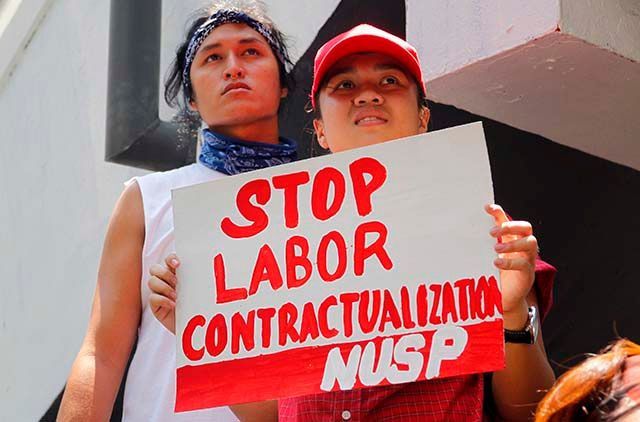
Employees protesting againts Endo or Contractualization and fighting for Regularization which is one of The Labour Problems Photo Credits: Center Media for Freedom & Responsibility https://cmfr-phil.org/media-ethics-responsibility/journalism-review/the-problem-of-endo-missing-links-unexplored-issues/
Kaufman, B. (2004). The Global Evolution of Industrial Relations: Events, Ideas, and the IIRA. Geneva: ILO IRRA. https://www.ilo.org/public/libdoc/ilo/2004/104B09_362_engl.pdf
Trade Union - it refers to the organization of workers in a particular trade, industry, or company constituted to secure decent work & protect the welfare of its members that originated in the 19th Century. They are workers usually covered by collective bargaining and participate in coercing the government to ratify rules or programs which will benefit their end.


Comments